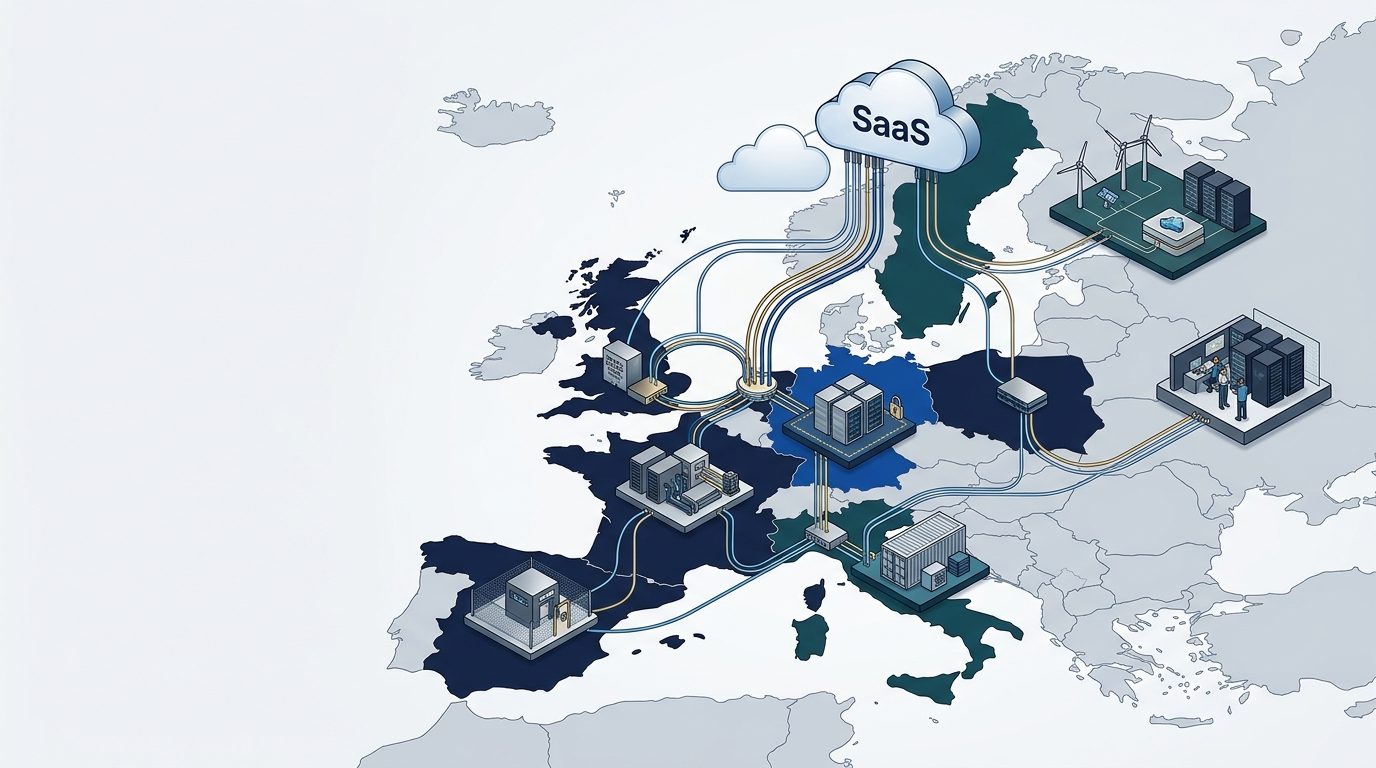
8 edge colocation factors for European SaaS teams.
The eight decision criteria SaaS and cloud teams should use to evaluate European edge colocation for ultra-low latency, carrier diversity and high-density workloads.
By John Wroath, Editor
Published 29 July 2026
European SaaS providers are hitting a wall that hyperscale cloud alone cannot solve. Users in Lyon, Stuttgart or Zaragoza expect the same responsiveness as users in Frankfurt or Amsterdam, yet most infrastructure still sits in a handful of core metros. Edge colocation closes that gap: placing compute closer to users through a distributed network of regional edge data centers, without giving up the control and economics of owning your own stack.
But not all edge colocation is equal. Choosing the wrong partner locks you into latency ceilings, connectivity dead ends and power constraints that surface exactly when you scale. Here are the eight factors mid-market cloud and SaaS teams should evaluate before signing.
1. Proximity to your actual users, not just the FLAP-D metros
Frankfurt, London, Amsterdam, Paris and Dublin concentrate most of Europe's colocation capacity, but they are not where most of your users live. If your customer base spans regional cities across Germany, France, Spain or the Nordics, the round trip to a core metro adds 10 to 30 milliseconds before your application even starts working.
Map your user geography against a provider's footprint. A genuine edge platform gives you dozens of facilities across multiple countries, so you can deploy where demand actually is. Ultra-low latency is a function of physical distance first and network engineering second. No amount of optimisation beats being 20 kilometres from the user instead of 500.
No amount of optimisation beats being 20 kilometres from the user instead of 500.
Ask the provider: where are your facilities relative to our top 20 user concentrations, and what real-world latency do you measure from each site to local eyeball networks?
2. Carrier diversity and network neutrality
Latency gains evaporate if traffic has to trombone back to a core metro to reach a carrier. Evaluate how many carriers, internet exchanges and cloud on-ramps are available at each site, not just at the flagship facility.
Carrier diversity matters for three reasons: resilience, since no single point of network failure; pricing leverage, since competition keeps transit costs honest; and reach, since different carriers perform differently into different eyeball networks. A carrier-neutral operator with dense local interconnection lets you build the blend that suits your traffic profile, and change it as you grow.
Ask the provider: how many carriers are live at each site we would use? Which internet exchanges can we reach locally, and is the facility genuinely carrier-neutral?
3. Power density and readiness for high-density computing
AI inference, real-time analytics and GPU-accelerated workloads are pushing rack densities from the traditional 4 to 8 kW toward 30, 50 or even 100 kW and beyond. Many older regional facilities simply cannot deliver that, and retrofitting is slow and expensive.
If high-density computing is anywhere on your roadmap, verify it now. Look for facilities that support high-density racks today, offer liquid cooling or a credible path to it, and can contract additional power as your footprint grows. The cheapest rack today can become the most expensive constraint in 18 months.
Ask the provider: what density can you support per rack today, what is your liquid cooling roadmap, and how much contracted power headroom exists at the sites we care about?
4. Scalability across a platform, not a single building
SaaS growth is rarely linear or predictable. You might need two racks in Madrid this quarter and a deployment near Munich next year. Evaluate whether the provider operates a coherent platform: consistent commercial terms, consistent operational standards and a single relationship across all locations.
Stitching together contracts with five regional operators multiplies legal overhead, fragments your SLAs and makes expansion a procurement project every time. A single edge colocation platform with a broad European footprint lets you land and expand with one master agreement.
Ask the provider: can we deploy in a new country under our existing agreement, and are SLAs, security standards and support processes identical across sites?
5. Connectivity to cloud: hybrid by design
Very few SaaS providers run pure colocation. Most operate hybrid: latency-sensitive and cost-sensitive workloads in colo, burst and managed services in public cloud. Your edge sites need low-latency, private connectivity into the major cloud regions your architecture depends on.
Check for cloud on-ramps, private interconnection options and partnerships that let you build a hybrid European cloud infrastructure without hairpinning traffic through public internet. The economics matter too: repatriating steady-state workloads from cloud to colocation is one of the most reliable margin levers available to a mid-market SaaS business, but only if the connectivity fabric supports it.
Ask the provider: what private cloud connectivity options exist from each site, and what does a typical hybrid architecture look like on your platform?
6. Data sovereignty and jurisdictional control
For SaaS hosting aimed at European enterprises and public sector buyers, where your infrastructure sits and who operates it is now a sales issue, not just a compliance one. Customers increasingly ask whether data stays within specific jurisdictions, which legal regimes apply to the operator, and whether the provider can evidence European operational control.
Evaluate the provider's ownership and operating structure, its ability to support in-country deployments, and its documentation for frameworks your customers reference: GDPR, NIS2, DORA for financial services customers, and emerging sovereignty frameworks. Choosing European-operated edge data centers can turn a due diligence hurdle into a differentiator in your own sales cycles.
Ask the provider: can you evidence European operational control, and how do you support customers responding to sovereignty requirements in tenders?
7. Sustainability and energy efficiency
Energy is both a cost line and a compliance obligation. The EU Energy Efficiency Directive now requires data centre reporting, and your own customers are pushing Scope 3 emissions questions down the supply chain. Regional edge facilities can also participate in heat reuse and grid flexibility schemes that large remote campuses cannot.
Look at PUE at the actual sites you will use, the renewable energy sourcing model, heat reuse initiatives and the provider's reporting capability. You will need their numbers for your own ESG disclosures, so make sure they can produce them.
Ask the provider: what is the measured PUE at our sites, how is power sourced, and what sustainability reporting will you provide us annually?
8. Operational support and remote hands where you have no staff
The whole point of edge is being in places where you do not have engineers. That makes local operational capability decisive. Evaluate remote hands availability and response times, on-site security, monitoring and the provider's track record on incident communication.
For a mid-market team, the provider's operations staff effectively become an extension of your own. Test them before you commit: raise a ticket during the sales process, visit a site, talk to a reference customer of similar size. Contractual SLAs matter, but responsiveness culture matters more at 3 a.m.
Ask the provider: what are your remote hands SLAs at each site, and can we speak to a customer running a similar distributed deployment?
Turning eight factors into a decision
No provider will be perfect on all eight. The right approach is to weight the factors against your own roadmap. If AI features are shipping next year, power density and cloud connectivity rise to the top. If you are expanding into regulated verticals, sovereignty and compliance documentation lead. If your user base is regionalising fast, footprint and carrier diversity dominate.
What should not be negotiable: a platform approach, genuine carrier neutrality and evidence rather than promises. Edge colocation is a long-term commitment, and the providers worth shortlisting are the ones who answer these eight questions with data, site visits and reference customers rather than a brochure.
Ready to evaluate? Talk to our team about mapping your user geography against a pan-European edge platform, or start with a latency assessment from the sites closest to your customers.
End of article
Related reading
What is European Sovereign Infrastructure? A working definition.
European Sovereign Infrastructure is digital infrastructure, including data centres, networks, and cloud platforms, that operates under European jurisdiction and control. It means three things hold at once: European law governs the data, European entities run the facilities and hold the keys, and technical measures make that control verifiable rather than merely promised.
John Wroath
What is European Sovereign Infrastructure? A working definition.
European Sovereign Infrastructure is digital infrastructure that operates under European jurisdiction and control. We set out a three-layer definition, test it against the frameworks Europe is now using to score sovereignty claims, and give buyers the questions that separate sovereign infrastructure from sovereign marketing.
John Wroath
Provable sovereignty: inside the Geneva confidential computing proof of concept.
A completed proof of concept in Geneva combined Intel TDX confidential computing with Arqit's quantum-safe key distribution to test whether sovereignty claims, jurisdictional, cryptographic, and computational, could be technically demonstrated rather than only contractually promised. It shows what the technical layer of sovereignty can look like in practice, without claiming to certify sovereignty on its own.
John Wroath
Primary sources
- EU Energy Efficiency Directive, European Commission
- NIS2 Directive, European Commission
- DORA Regulation, European Commission
- GDPR, European Commission
Disclosure: 8 edge colocation factors for European SaaS teams. is published as part of Edition 01 of European Sovereign Infrastructure. The publication is editorially independent. No source cited in this article had sight of the copy before publication.