CADA's real fight is over the private sector. Map your workloads before Brussels settles it.
The Parliament's rapporteurs want CADA to reach regulated private companies. The Council has just cut the clause that would let it. Either way, the planning work is the same.

The Cloud and AI Development Act is usually described as a public procurement law. This month the two co-legislators showed that the real argument is about whether it reaches into private companies. The Parliament's rapporteurs want it to. The Council has just removed the clause that would let it.
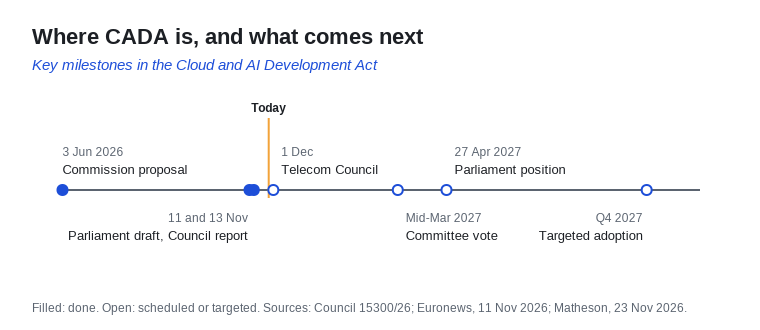
Within a few days of each other, two documents went in opposite directions. On 11 November the Parliament's co-rapporteurs, Diego Solier and Reinier van Lanschot, presented their joint draft report on the Commission's June proposal. Two days later the Irish Council Presidency circulated a progress report on its own compromise text, ahead of the Telecom Council on 1 December.
Read side by side, they disagree on the question that matters most to a private CIO: will CADA ever tell a bank, an energy company or a hospital group which cloud it may use for which workload?
Neither text is law. The Parliament plans to fix its position in April 2027 and the Council's roadmap targets adoption in Q4 2027. But the gap between them is now wide enough that buyers should plan for both outcomes, and the planning work turns out to be the same.
What did the Parliament's rapporteurs propose?
Start with what the Commission put on the table. The June proposal creates four Union assurance levels for cloud services and obliges public bodies to use them. For private firms in high-criticality sectors it stopped short: assessments were left voluntary, with a Commission power to make them compulsory later by delegated act, as the Sovereignty Atlas notes in its reading of Article 31(3).
The rapporteurs appear to want to skip that step. According to reporting by Dataconomy and Borncity, their draft would require high-criticality NIS2 entities to identify which of their cloud workloads are critical and run each one at no less than the matching CADA level. The full text of the draft report had not been published when this article went to press, so the detail may still change.
The same reports describe a new Article 47a that would let public bodies terminate existing cloud contracts that fail the new standards, without paying compensation.
The political framing is blunt. Van Lanschot told the launch press conference that if your systems run on another's infrastructure, "someone else can switch it off", as Matheson's summary records.
What did the Council take out?
The Council went the other way, and its document is primary. The Presidency's progress report of 13 November records that the Commission's delegated-act power to extend risk assessments to the private sector has been deleted. That was the only route by which the original text could have reached private companies.
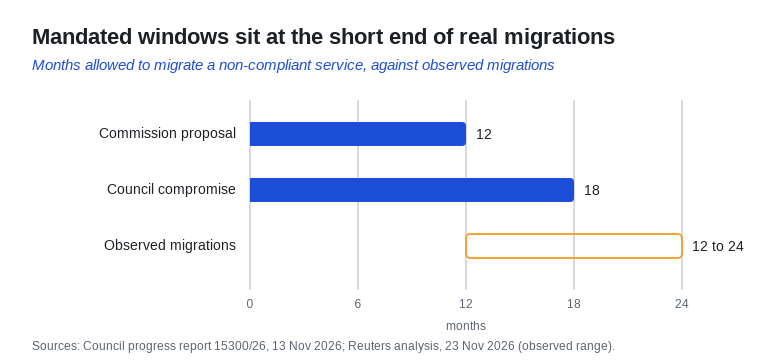
The compromise also softens the public-sector rules. It lengthens the mandated migration period from 12 to 18 months, pushes the date of application from 12 to 18 months after entry into force, moves audit reviews from annual to every two years, and drops an exact procurement percentage target. National security and defence fall outside the risk assessments altogether.
One thing the Council added matters for the private side too. Procurement scope now extends to utilities buying under Directive 2014/25/EU, so electricity and water operators come into the public-buyer rules even as private firms in general are kept out.
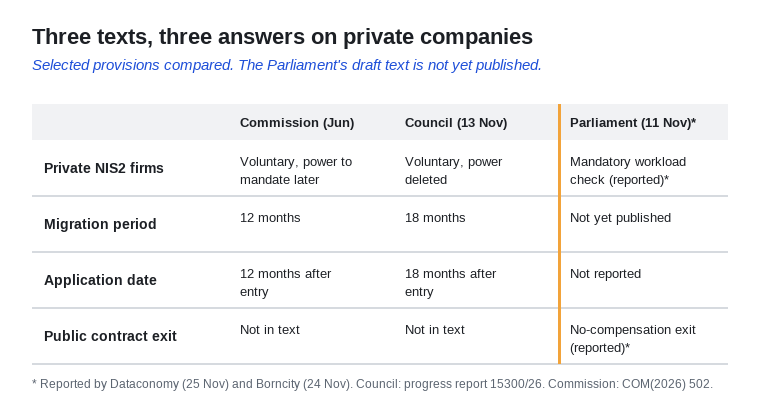
In short: the Parliament draft would make sovereignty a compliance duty for regulated private firms. The Council text would make it a choice.
Why should a private company care about the outcome?
It is tempting to read the Council text as the likely floor and relax. That would be a mistake, for three reasons.
First, the assurance levels will exist whatever happens to Article 31. Once public bodies are buying against four defined tiers, those tiers become the vocabulary of the market. A SaaS or fintech platform that sells into the public sector, or into utilities now inside the procurement scope, will be asked which level each of its services meets. The requirement arrives through the contract, not the statute.
Second, migration is slow and capacity is thin. A Reuters analysis published on 23 November puts the share of the three US hyperscalers in Europe above 70 percent, with European providers falling from 29 percent in 2017 to 15 percent in 2022.
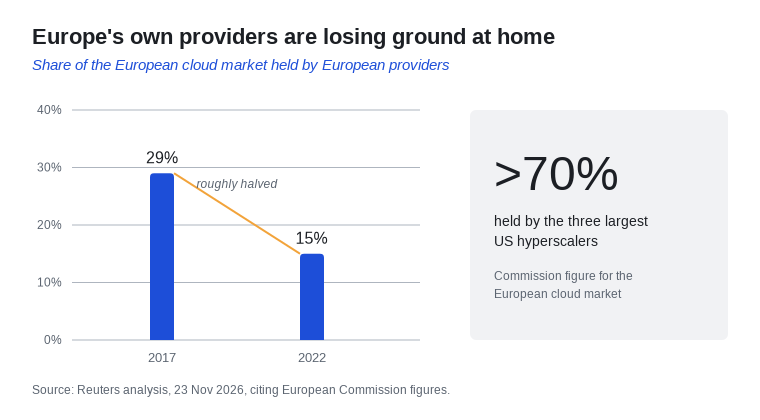
It cites T-Systems reporting more than fourfold growth in sovereign-cloud demand since mid-2025, IONOS saying only a single-digit share of public-sector talks become contracts, and migrations taking 12 to 24 months. If the Parliament's version survives, every regulated firm hits that queue at once.
Third, the exit right changes the risk on the other side of the table. If public bodies gain a no-compensation termination right for contracts that fail the standards, providers will price that risk, and so will anyone who resells their services.
We argued in October that the market is splitting into tiers, with US sovereign subsidiaries credible for the middle and not the top. CADA's fight over Article 31 decides whether private firms have to place their own workloads on that ladder, or merely choose to.
Where is this likely to land?
The calendar is long. According to Matheson, the committee vote is pencilled for mid-March 2027 and the plenary for April. The Council document puts the Parliament position on 27 April 2027 and targets adoption in Q4 2027, with the Presidency starting a second compromise text in December.
Trilogues usually split differences. The most plausible landing, in our view, is neither a blanket duty nor a pure opt-in: something like a mandatory assessment for the most critical NIS2 sectors with a long phase-in, or a restored delegated-act power with tighter conditions. Readers who think the Council will simply hold its line have a fair case, since Member States are protecting their own national schemes. But the direction of travel across both texts is towards defined tiers, not away from them.

What should a CIO do before April?
The useful work is the same under either outcome, which is the point of this piece.
- Build a workload register now. List each production workload, the data it touches and who could be legally compelled to hand that data over. That is the question the assurance levels are built around.
- Pre-classify against the four levels. Use the Commission's annex criteria as a working draft. Expect them to move, but the shape will hold.
- Price the exit, not just the entry. With mandated migration windows of 12 months in the Commission text and 18 in the Council's, know which contracts you could leave and what it would cost.
- Ask suppliers the tier question in writing. If you resell cloud services to public buyers, assume they will ask you the same.
The Council has made CADA easier on private companies. It has not made the question go away. It has only moved it from the statute book into the procurement file.
Sources
- Euronews, EU lawmakers push to reduce Europe's dependence on foreign cloud providers, 11 Nov 2026
- Council of the EU, Progress report 15300/26 on the Cloud and AI Development Act, 13 Nov 2026
- Reuters via The Star, Europe's cloud sovereignty push gains ground, but US hyperscalers remain dominant, 23 Nov 2026
- Matheson, European Parliament presents draft report on the Cloud and AI Development Act, 23 Nov 2026
- Borncity, CADA-Entwurf: EU-Parlament will Rechenzentrumskapazität verdreifachen, 24 Nov 2026
- Dataconomy, European Parliament draft pushes tougher cloud and AI sovereignty rules, 25 Nov 2026
- European Commission, Proposal for the Cloud and AI Development Act, 3 Jun 2026
- Pharos Futures, The EU Technological Sovereignty Package: Briefing Atlas, 4th edition, 13 Oct 2026