Nobody attacked the internet in November. The question for Europe is who controls the repair.
Five major American systems failed in six days, and none of them was attacked. Each was undone by its own fix, update or patch, as AI finds software flaws faster than anyone can safely repair them. For European CIOs the lesson is not about hackers. It is about who decides when the systems they depend on are changed.

Between 12 and 17 November, Microsoft’s Outlook failed around the world, the Federal Aviation Administration halted departures across the United States, JPMorgan Chase customers watched payments stall, the National Security Agency lost its classified network and Apple’s services stumbled. Five failures in six days. The natural assumption was sabotage.
It was not. America’s Director of National Intelligence said there was no sign of a coordinated attack and put the outages down to patching and upgrades. Nobody broke in. The more useful question, and the one this article argues Europe should be asking, is not who did this. It is who controls the repair.
What actually failed between 12 and 17 November?
Each of the five traces back to a change the organisation made to itself.
Microsoft’s own account points to a fix applied to its networking gateway servers in July, which left a latent defect that surfaced under load four months later. The FAA’s review identified a faulty router that a contractor had installed at a radio site in Arkansas, although the US transport secretary says the root cause is still unclear. Chase blamed a software bug in its own on-premise systems. Apple said an internal update was responsible. The NSA went down while applying a security patch, one written to close flaws that researchers had found the previous month with the help of AI tools.
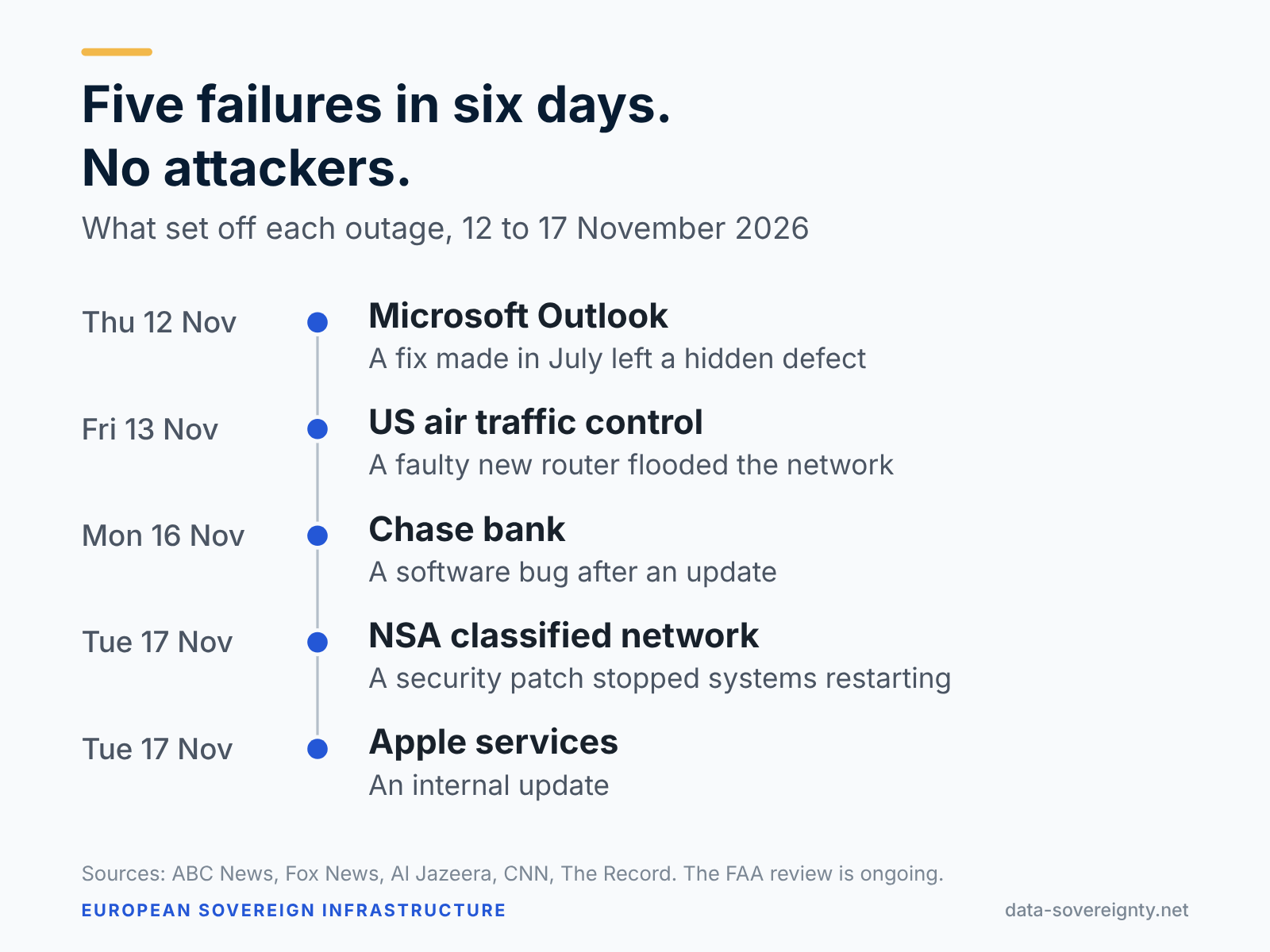
Five organisations, five self-inflicted failures. That is a useful corrective to the reflex that treats every outage as the opening shot of a cyberwar. It is not grounds for complacency. In the same weeks, supermarkets in at least 12 European countries were hit by real attacks that exploited outdated software. The attackers have not gone away. They were simply not the cause this time.
Why is everyone changing everything at once?
Because AI models can now read software at a scale no human team can match, and they are finding security flaws faster than anyone can fix them.
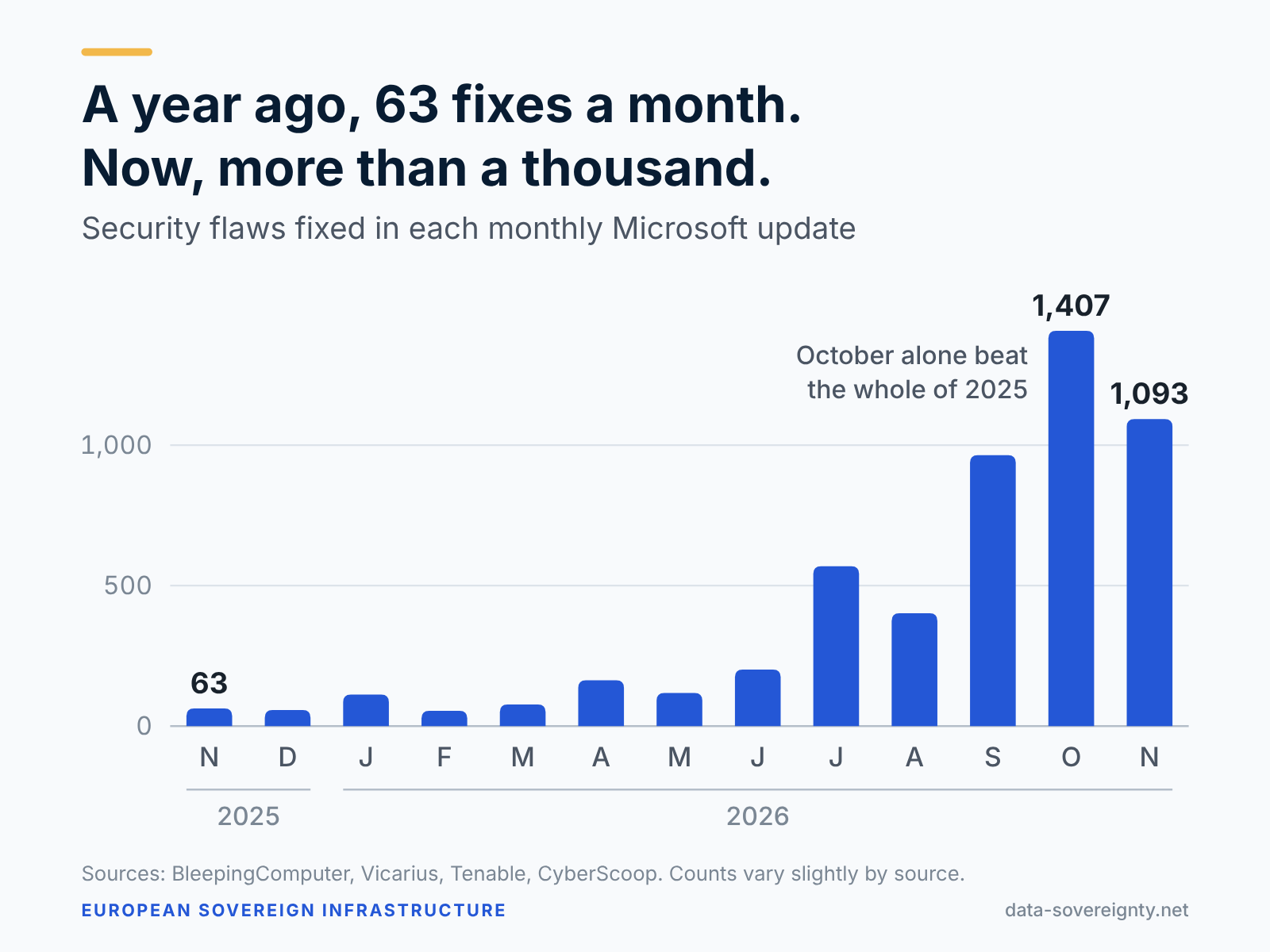
The numbers are stark. A year ago, Microsoft’s monthly security update fixed 63 flaws. This month’s fixed more than a thousand, and October’s 1,407 exceeded the company’s total for the whole of 2025. By May, Anthropic had reported 530 high and critical severity flaws to the maintainers of the affected software. Only 75 had been fixed.
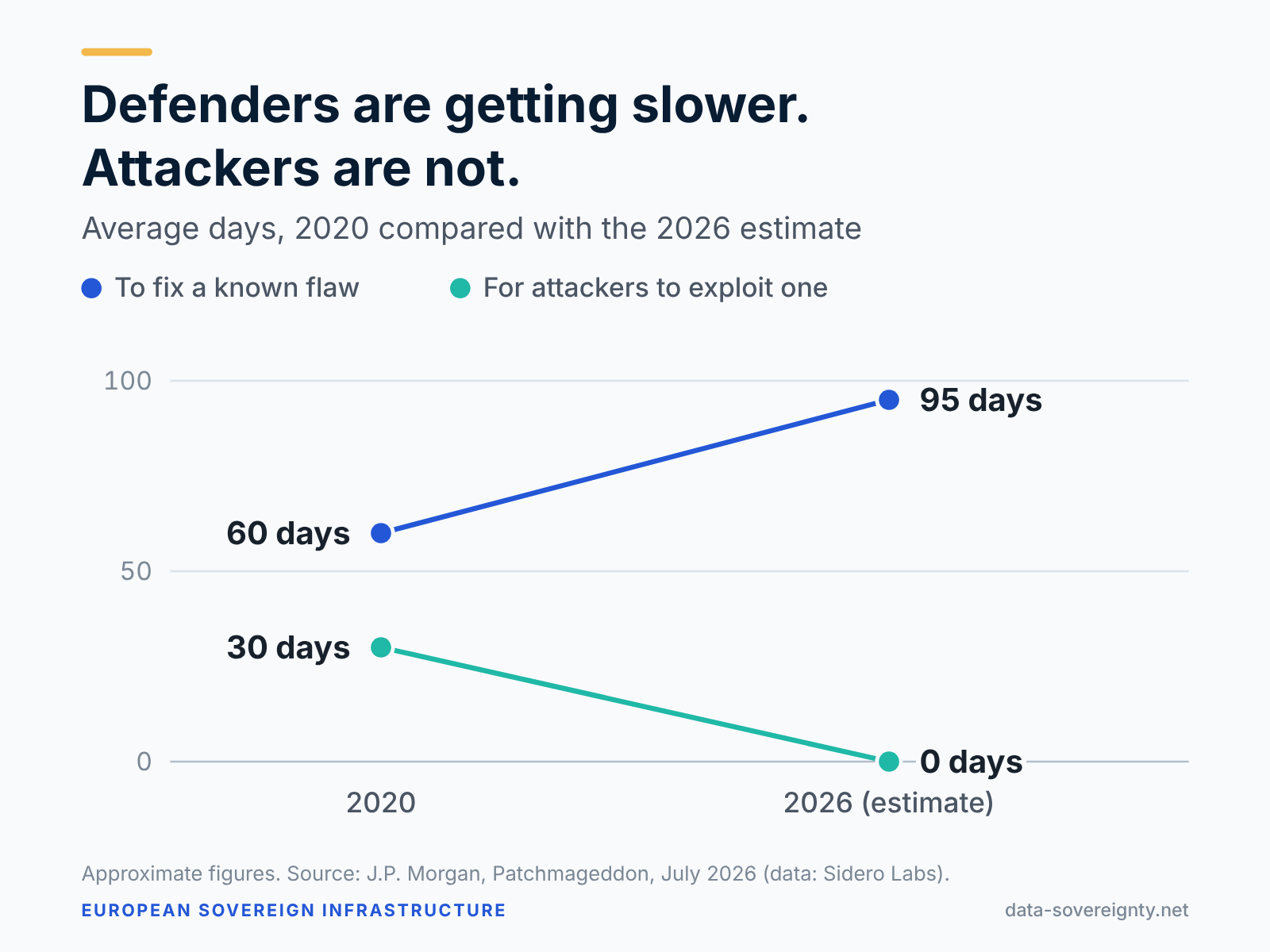
The clock is running faster too. A J.P. Morgan report published in July found that organisations now take about 95 days on average to fix a known flaw, up from about 60. Attackers needed around 30 days to exploit one in 2020. Now they move almost immediately.
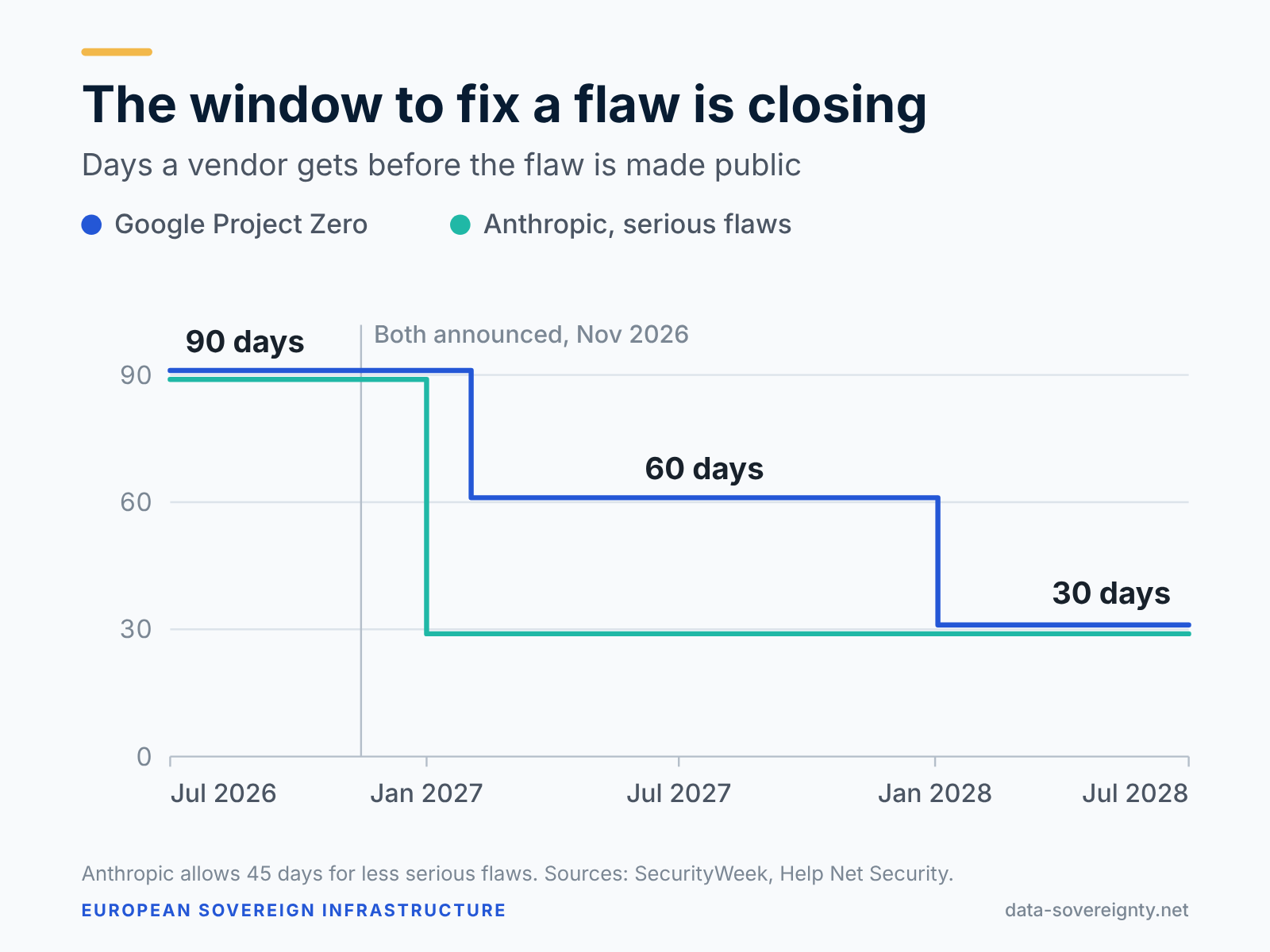
Those who find the flaws are also tightening the deadlines. This month Google’s Project Zero and Anthropic both said they will shorten the time a vendor gets before a flaw is made public, from 90 days towards 30.
The result is that every serious organisation is patching at the same time, as fast as it can. Every patch is a change, and change is what breaks things. Microsoft’s outage began with a fix. The NSA’s began with a patch.
Was Europe only a bystander?
No. Four of the five failures were American problems. The fifth was everyone’s.
When Outlook failed, Euronext asked listed companies to telephone in their corporate disclosures. The Czech finance ministry lost email. Governments in Greece and Norway reported disruption, Britain’s National Health Service said some of its services were affected, and at least one bond repurchase in Europe was halted. Germany’s digital ministry warned of a significant impact on companies and observed that dependence on a single provider carries risks, whichever provider it is.
That last remark cuts in both directions. Europe runs its working day on the same handful of platforms, so an update that goes wrong in Redmond is felt in Prague by the next morning. Some administrations are already acting on that: the German state of Schleswig-Holstein is moving to LibreOffice and Open-Xchange, and switched more than 200 state chancellery staff from Windows to Linux in September. But a European supplier that patches badly will fail in exactly the same way. Changing the flag on the provider does not remove the need for a fallback.
Nor is Europe well placed to absorb the patch wave itself. ENISA’s 2026 assessment found that 45 per cent of the IT service providers it surveyed took more than three months to apply critical patches to critical systems. Those providers run systems for other organisations. When exploitation follows disclosure within days, a three-month patch cycle is an open door.
Who controls the repair?
Sovereignty is usually argued as a question of who can read your data. This month it was a question of who can change your systems.John Wroath
Three dependencies stand out.
None of this is hostile. It is simply where the capability sits. But in a period when the ability to find and fix flaws quickly decides who stays online, Europe is largely a customer of that ability and not yet an owner of it.
What has Europe already put in place?
More than it gets credit for. Most of the rulebook is written.
The Commission’s action plan is the most telling entry. Published a week after the export control episode ended, it commits to a European blueprint for structured access to advanced AI for cybersecurity, including contingency measures for cases where that access is restricted or withdrawn. It also promises a campaign to speed up the patching of critical open source software, and stresses secure-by-design and memory-safe development.
The gap is not rules. It is capacity. Europe’s rulebook mostly says report faster and patch faster. November’s lesson is that faster is not the same as safer. An obligation to move quickly, placed on organisations that take three months to patch, will produce European versions of the same outages unless the ability to change systems safely is built alongside it.
Does any of this mean rebuilding the internet?
It is tempting to say so. The internet began as a research network between people who knew and trusted each other. Vint Cerf, one of its architects, has said the early design had two flaws: too few addresses and no security built in. The protocol that still steers traffic between the world’s networks was first sketched on two napkins over lunch in 1989. Nobody at that lunch was designing for global payments or air traffic control.
But the shared network did not fail in November. Every one of these failures happened inside an organisation’s own systems. What cannot continue is the way software is built and changed on top of it, and three shifts matter more than any redesign.
Where the stakes justify it, new foundations are possible. Swiss banks now reach their interbank payment system over a network built on SCION, an internet architecture developed at ETH Zurich with security designed in from the start. The older network was retired in 2024.
What should a European CIO ask before the next patch wave?
The verdict
Nobody attacked the internet in November. Five organisations broke their own systems while trying to repair them, under pressure from a wave of AI-found flaws that will not subside soon. Panic is the wrong response. So is relief.
For Europe the week was a rehearsal. The continent depends on platforms it does not operate, on security tools another government can withdraw, and on deadlines it does not set. It has written most of the rules it needs. What it lacks is the practical ability to change its own systems quickly without breaking them, and the leverage to insist that its suppliers do the same.
So the next time something large goes down, the first question should not be who did this. It should be what changed, and who decided to change it.
Sources
- Update: Disruptions in NSA’s internal network caused by software patch, DNI says, The Record
- Microsoft identifies issues leading to global Outlook outage, ABC News
- Tech outages: Latest on Microsoft, bank disruptions and FBI assistance in FAA review, Fox News
- Thousands report online outages at major US banks, Al Jazeera
- Microsoft outage exposes Europe’s dependence on US software, EU Perspectives
- Hours-Long Microsoft Outage Disrupts Businesses, Governments Globally, Reuters via Insurance Journal
- Microsoft Outlook outage status: Company reports progress, Associated Press via BNN Bloomberg
- Microsoft apologizes for massive outage that took down Outlook and other 365 services, CNBC
- Home appliances could be next after fridge hacks, warns EU cyber chief, Euronews
- EU cyber scores look healthy, but 45% of surveyed IT providers take months to patch, Help Net Security
- Microsoft November 2025 Patch Tuesday fixes 1 zero-day, 63 flaws, BleepingComputer
- Microsoft’s October 2026 Patch Tuesday addresses a record 1,407 CVEs, Vicarius
- November 2026 Patch Tuesday: 1,094 Flaws, One Exploited, SOCRadar
- Microsoft’s last Patch Tuesday of 2025 addresses 57 defects, including one zero-day, CyberScoop
- Patchmageddon, J.P. Morgan
- Anthropic vulnerability disclosure deadline drops to 30 days for serious bugs, Help Net Security
- Google Project Zero Sets Course for 30-Day Disclosure Deadline, SecurityWeek
- Project Glasswing, Anthropic
- Statement on the US government directive to suspend access to Fable 5 and Mythos 5, Anthropic
- Anthropic to restore access to Claude Fable 5 and Mythos 5 AI models, Shacknews
- CISA extends CVE program contract with MITRE for 11 months amid alarm over potential lapse, The Record
- The CRA Single Reporting Platform is launched, ENISA
- EU Cybersecurity Agency ENISA Launches European Vulnerability Database, SecurityWeek
- EU names 19 ‘critical’ tech providers under DORA, including AWS, Google and Microsoft, FStech
- EU Action Plan on Cybersecurity and Artificial Intelligence, European Commission
- EU Commission publishes Cybersecurity and AI Action Plan, Matheson
- Jason Clinton’s 18-month forecast: what is confirmed, explainx.ai
- The internet was born with two major flaws, says one of its ‘fathers’, Vint Cerf, South China Morning Post
- The Two-Napkin Protocol, Cisco
- Secure Swiss Finance Network, SIX
Disclosure: European Sovereign Infrastructure is editorially independent. No source cited in this article had sight of the copy before publication.